
Toy Photography and the Scene That Built Itself
- TeamBay
- Jun 19
- 5 min read

Stephanie DeFranco on scene construction, creative constraints, and what happens when the subject is two inches tall.
Sometime in 2020, Stephanie DeFranco ran out of subjects.
Her clients weren't available. The world had closed. She had a camera, time she hadn't asked for, and a few LEGO sets that her cats hadn't yet dismantled. So she set up a figure, pointed her lens at it, and started building scenes from whatever she had nearby.
That was the beginning of her toy photography practice, though she didn't have a name for it yet.
She Wasn't Planning to Become a Toy Photographer

Toy photography arrived because the alternative -- sitting with a camera and nowhere to point it -- wasn't an option. She had Harry Potter sets, Disney sets, plastic figures with frozen expressions and articulated limbs.
What started as a way to pass the time became something she couldn't stop doing.
She built a quarantine-era series from those figures -- small, strange, specific scenes about what everyone was going through. Recreations of her clients in toy form. A stormtrooper navigating the same absurdity as everyone else.
How a Toy Photography Scene Comes Together

There is no shot list. There is no mood board. Usually, there's just one figure and a vague sense of direction.
"My creative process usually starts with one item or toy, and I build off that," Stephanie explains. "I'm not someone that plans every little detail out because the element of play is what really brings the final shot together."
This is a workflow built around the idea that over-planning can close off what a scene might become. She'll pick a character and head outside to see what the environment offers. The stool. The light. Whatever happens to be available.
Sometimes what happens to be there is a bug.
Two of her favorite toy photography images feature insects that showed up uninvited and landed exactly where she never could have planned for them to be. She photographed them both times. "There would have been no way to plan for this," she says, "but I still managed to create a fun shot with what was available at that time."
A photographer who had locked in a specific vision before heading outside would have moved the bug. Stephanie photographed it. That distinction -- the willingness to recognize when something unplanned is better than the plan -- is a skill that develops slowly. Toy photography, which strips the process down to a figure and whatever the world provides, trains it faster than most genres do.
Want to see Stephanie's process in action? Watch her build and photograph one of her toy photography scenes from start to finish.
The Props That are Overlooked in Toy Photography Every Day

The best props rarely look interesting at first.
Stephanie gravitates toward things most people set aside without thinking: cardboard inserts from inside shipping boxes, cups with unexpected colors, a candle holder with a reflective surface. Not because they're visually striking on their own, but because macro photography changes what they are.
"All of these photos are done in macro," she points out, "so the perspective of smaller items tends to look different." A corrugated cardboard channel becomes an architectural backdrop. A reflective surface becomes depth. The funky-colored cup becomes a color field that directs the eye exactly where she needs it.
The resulting prop kit costs almost nothing. When the budget is zero, the problem becomes finding objects worth photographing -- a harder and more transferable skill than buying the right equipment.
Why Posing Still Matters in Toy Photography
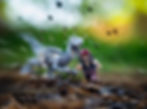
"Posing with intention" is how she describes it, and the language is borrowed directly from portrait work -- where it means something precise. Head position. Eye direction. Body language. These details change what a frame communicates, whether the subject is six feet tall or two inches.
"If there is distress happening, make it feel like the figures are stressed. If the characters are running, make sure to lean them like they would be running."
A stormtrooper standing at attention tells you one thing. The same figure, head slightly tilted, weight shifted, tells you something else. The plastic hasn't changed; the posing has. And the photograph the viewer looks at is different because of it.
This is the part most beginners skip, and it's what separates a setup that reads as toys from one that reads as a scene.
What Toy Photography Does to Creative Thinking Over Time

Photography conversations tend to center on equipment, conditions, locations, and access. Toy photography eliminates most of them. The subject is whatever figure is available. The set is wherever the scene comes together. The lighting is whatever the sun is doing.
Working at that scale trains a specific kind of attention. "The slightest adjustments could change the entire atmosphere," Stephanie says, "going from a plastic toy on a table to a believable character in a living world." There's no margin for missing a shift in light or a degree in head position. The constraints don't just build patience -- they build precision.
"The process has strengthened my ability to think creatively under limitations -- a skill that translates directly to any form of photography."
Photographers who spend time in toy photography tend to return to their primary genre noticing things they'd stopped seeing.
When Toy Photography Meets a Print That Does It Justice

When her Acrylic Print arrived, the first thing Stephanie noticed was how much detail had been lost to the screen.
Her toy photography images are built from small things -- figures, insects, textured household objects -- and she'd been living with them at scroll size. The print showed her what those details look like when given room to be examined. "Because we're viewing photos on screens these days, a lot of the details get lost with the half-second scroll. To be able to take the time and look at the details in a print really adds to the experience."
The texture in her work -- the surfaces, the cardboard grain, even the wing of an uninvited bug -- had always been there. The print let it be seen.
The Toy Photography Sitting on Your Hard Drive

Stephanie has a clear opinion about the images sitting on photographers' drives, unseen.
"A photograph on a screen is often viewed for a few seconds before someone scrolls past it. A print invites you to slow down, study the details, and engage with the image in a much more intentional way."
An image on a hard drive contains the same pixels as an image on a wall. What it doesn't have is presence. It doesn't occupy space. It doesn't create the moment where someone stands in front of it and stays there.
That's what Bay Photo exists to change. Whether the subject is a landscape, a portrait, or a two-inch stormtrooper on a backyard stool -- the work deserves to be seen the way Stephanie describes: unhurried, up close, and printed on a surface that holds every detail you put into the frame.
She built an entire world from one figure, a backyard stool, and a bug she didn't invite. Bay Photo printed it on Acrylic which gave those details the space to be seen.
If you have toy photography -- or any photography -- sitting on a hard drive waiting for the right moment, an Acrylic Print may be the reason to finally bring it off the screen and into the real world.
Designed specifically with professional photographers and artists like you in mind.
Stay connected with us on:
Images by:
Stephanie DeFranco